The Jobs Apocalypse: A Brief History of AI-Induced Unemployment

In the history of polling, Americans have never been as pessimistic about long-term job prospects as they are now. A survey shows that the average person believes there is a 22% chance of losing their job in the next five years, higher than during the 2007-2009 global financial crisis. This gloomy sentiment is largely attributed to artificial intelligence (AI). Another poll reveals that nearly one-fifth of American workers believe that AI or automation technologies are “very likely” or “somewhat likely” to replace them.
It’s not just the general public feeling anxious; even the leaders of AI companies are concerned. Dario Amodei of Anthropic has warned that AI could push unemployment rates to between 10% and 20%. Microsoft co-founder Bill Gates has stated that in an AI-driven world, humans will no longer be needed for “most things.” OpenAI’s CEO Sam Altman has acknowledged that the hype surrounding this technology is causing backlash, now referring to it as a “tool to augment and enhance humans, rather than replace them.” However, he still mentions a significant transition involving disruption and new job creation.
Economists, on the other hand, are unusually optimistic. They disdain the “fixed pie fallacy”—the misconception that the job market is a static zero-sum game. Economists argue that if technology displaces workers in some industries, it simultaneously benefits workers in others, who will then spend their income on goods and services, creating new job opportunities.
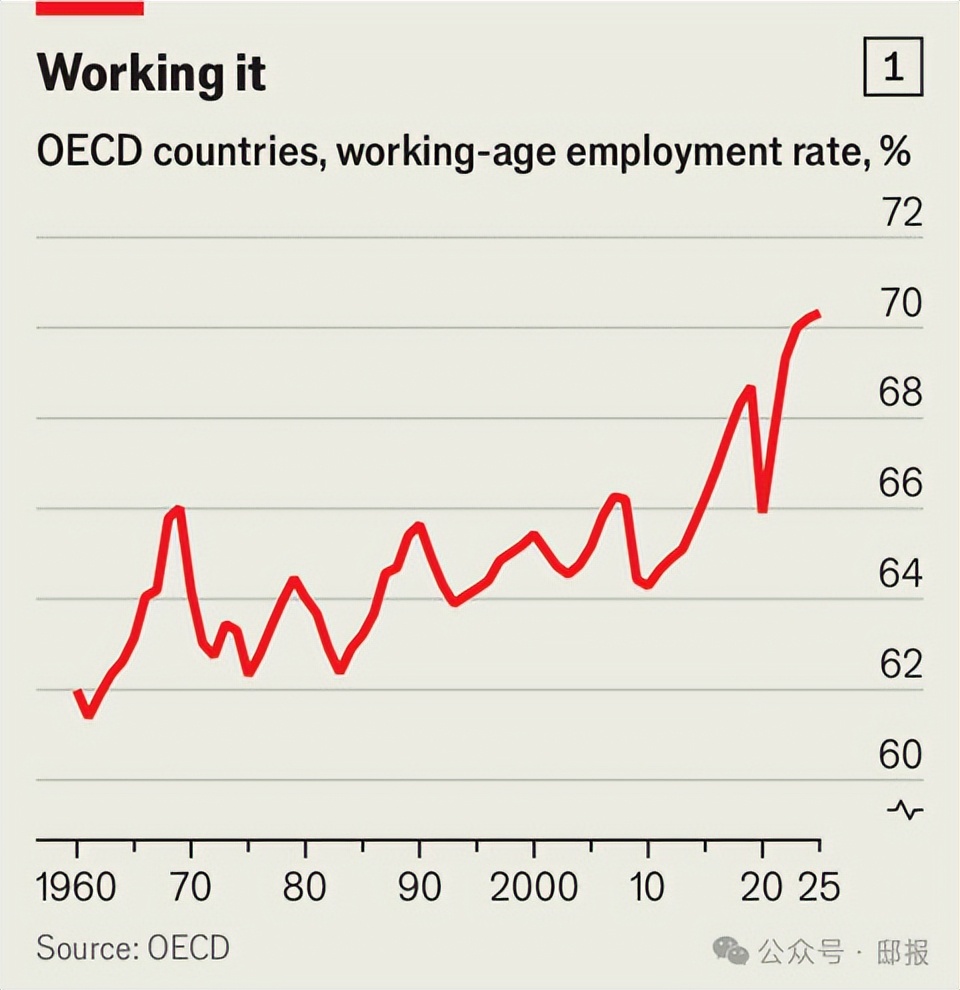
Currently, there are no cracks in the job market. The employment rate among the working-age population in OECD countries continues to reach historical highs, with the unemployment rate in this wealthy club of nations at just 5%. The number of jobs in AI-related sectors in the U.S. is higher than ever. American college graduates were already struggling before OpenAI launched ChatGPT at the end of 2022. Many economists predict that future impacts will be relatively limited. Economists from the U.S. Bureau of Labor Statistics expect that between 2024 and 2034, the U.S. workforce will grow by 5.2 million, a 3% increase in total employment.
The rapid advancement of AI capabilities may render current data and projections obsolete. However, if AI does lead to long-term unemployment for millions, it would be unprecedented in human history. The spread of new technologies has never been fast enough to cause widespread, long-term job loss. Understanding the reasons behind this may reveal what aspects of this situation are similar to or different from the past.
Historical data shows that technological diffusion is always a slow process. Robert Gordon of Northwestern University found in a 2012 paper that since 1300, no advanced economy has ever seen a per capita GDP growth rate exceeding 2.5%. When other countries exceed this rate, it is typically because they are catching up to wealthier places that have pioneered technological progress. Because growth in leading economies is relatively slow, the pace of job loss also slows.
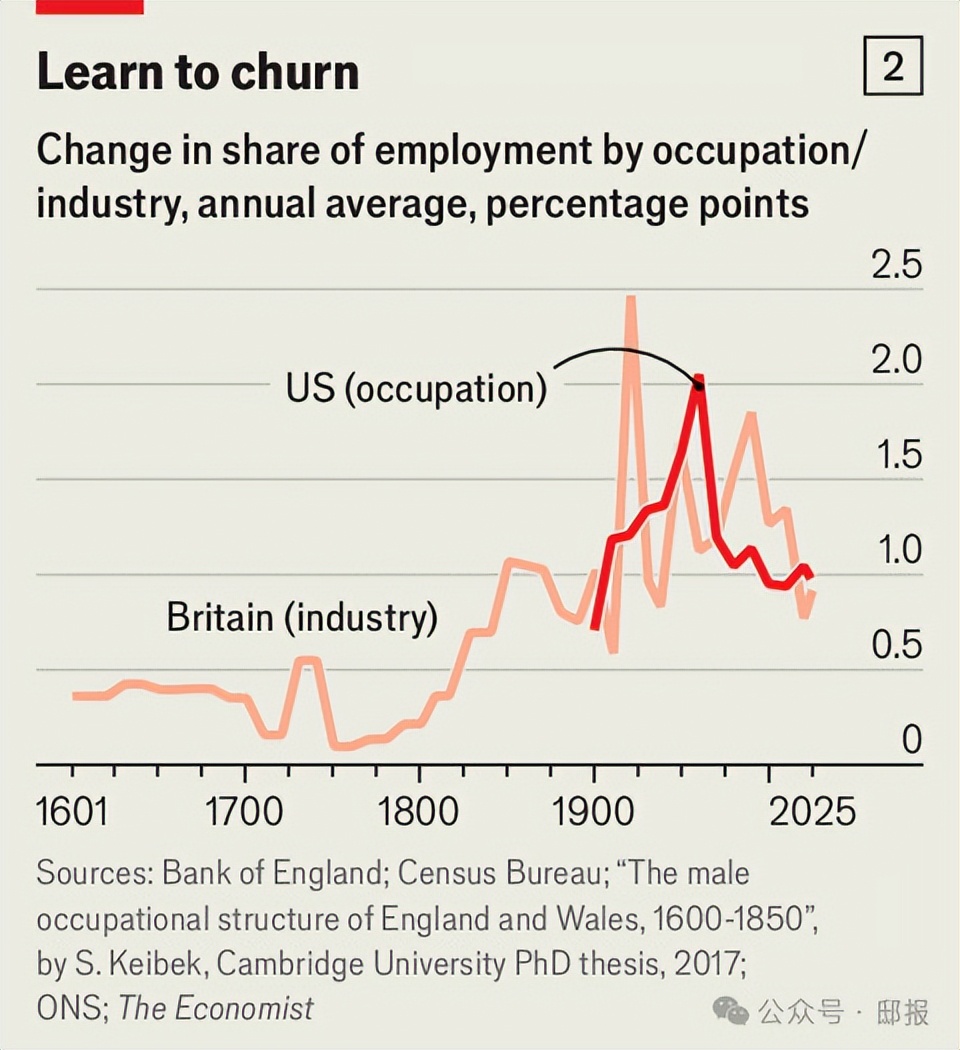
Take agriculture as an example. Despite undergoing dramatic technological changes over the past thousand years, the shift in agricultural employment has been gradual. The proportion of the British labor force engaged in agriculture has steadily declined since the 16th century, but there has never been a sudden collapse. The modern tractor emerged in the early 20th century in the U.S., but the shrinkage of agricultural labor took generations, not years.
Even if the speed of job displacement due to technology increases, workers may not suffer as much. In the mid-20th century, groundbreaking inventions like the first computers and containers led then-Prime Minister Harold Wilson to describe the Western economy as experiencing a “technological fever.” At that time, the U.S., which had surpassed Britain as the leading economy, saw a per capita GDP growth rate of 2.5%, the highest in history for leading economies. By measuring the proportion of employment shifts between industries or occupations, the intensity of job displacement at that time was more than double what it is today. Yet many remember that era fondly as a time of rising wages, abundant opportunities, and political harmony.
One technological transformation that has a notorious reputation is the Industrial Revolution in 19th-century Britain. It is often said to have caused significant harm to workers. James Watt’s inventions from the 1760s to the 1780s greatly improved the efficiency of steam engines, enough to power factories. The resulting rapid economic growth coincided with stagnation in real wages. From 1790 to 1840, wages adjusted for inflation barely budged, while capitalists profited immensely.
Silicon Valley “thought leaders” often cite this period of stagnation. It is associated with Friedrich Engels, the communist born into capitalism, who described the dire conditions of the Manchester slums in the 1840s in his work “The Condition of the Working Class in England.” However, recent academic research questions whether the “Engels Pause” can serve as a template for predicting the impact of AI on labor.
The significant changes in the employment structure in Britain did not occur until the 1850s, and subsequent fluctuations were comparable to today. Moreover, while technology destroyed old jobs, it also created many new ones. Between 1760 and 1860, the British workforce grew from 4.5 million to 12 million, with the unemployment rate remaining low overall.
While wage growth during the “Engels Pause” was indeed slow, it was not slower than in the preceding half-century. This reflects the slow productivity growth during the early Industrial Revolution, which was itself a product of the gradual diffusion of Watt’s technological breakthroughs. By 1830, the total use of steam power in Britain was only about 160,000 horsepower, equivalent to 1,000 ordinary modern cars. The late British demographer Sir Tony Regan pointed out that in an era of rapid population growth, it was an “extremely rare achievement” for workers to see any increase in purchasing power. If one uses the average domestic output price (the “GDP deflator”) rather than the consumer price index to calculate real wages—historian typically use the latter—this achievement appears even more remarkable.
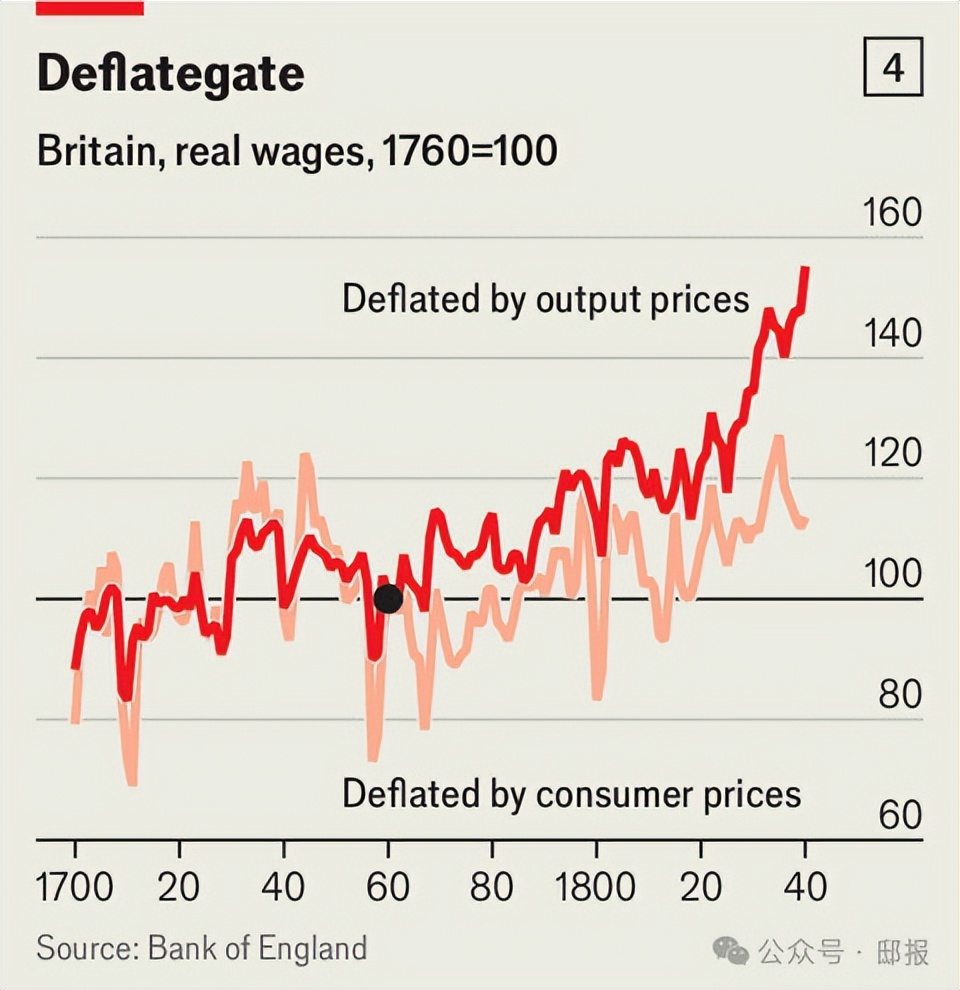
The difference between these two measures of real wages reveals a key truth about the Industrial Revolution. Ordinary employers did not pay low wages to workers after selling goods and deducting material costs; they did not profit by exploiting employees as Engels envisioned. The issues faced by laborers were less about wage injustice and more about the rapid rise in living costs. Food prices soared due to war and high grain import tariffs, sometimes even skyrocketing. The true culprits of the Industrial Revolution were politicians, not machines.
This provides a new perspective on the labor movements of that period. In the early 19th century, textile workers revolted, destroying power looms they believed would doom their craft; years later, agricultural workers in southern England swept through, smashing threshing machines. Historians have linked these riots to technological shocks, but strikes and destruction have always existed. In Britain, riots were actually rarer in the early 19th century—the very middle of the “Engels Pause”—than in the later century when real wages were rising robustly. As for the Chartist movement advocating for male suffrage and other rights, it only gained momentum after the wage stagnation ended in the 1840s.
Economic historian Nicholas Crafts succinctly stated: the Industrial Revolution “cannot serve as a template” for predicting technological changes that drive productivity gains at the expense of labor’s share of national income. In short, those warning that AI will lead to mass unemployment are describing something that has never happened in history.
However, just because it has never happened does not mean it will never happen. The initial warning signs would be a significant leap in productivity, alongside stagnant real wage growth in the U.S., as a leading global economy. This would manifest as per capita GDP exceeding Gordon’s 2.5% ceiling, with corporate profits rising sharply—indicating that the benefits of output growth are flowing to capital rather than labor—and widespread layoffs across many industries.
History also leaves us with a final lesson. If a shock does come, it will manifest during an economic downturn. During each recession, economies shed low-productivity jobs: companies are forced to undergo fundamental transformations, weak firms fail, and capital and labor flow toward higher productivity. Almost all jobs that once existed in the U.S. have disappeared during past recessions. Which jobs vanish in the next downturn will be crucial for interpreting the landscape of the AI era. Until then, whether it is Amodei, Gates, or Altman, everyone will remain in the dark about the true nature of the AI world.
Comments
Discussion is powered by Giscus (GitHub Discussions). Add
repo,repoID,category, andcategoryIDunder[params.comments.giscus]inhugo.tomlusing the values from the Giscus setup tool.